Tuesday, 11 December 2018

A Review of Piglettes

Piglettes is a book by Clementine Beauvais, translated by Clementine Beauvais. Mireille, Astrid and Hakima have been voted the ugliest girls in school on a Facebook page. The girls make friends, and find themselves cycling around the French countryside on a trip to Paris.

I think overall, this reads a little younger than some YA, but I wouldn't recommend it to a younger set because of some of the topics covered. I didn't hate it, but I didn't love it either.

Translated YA needs to have a day. I want more books where I read about countries written by someone from that country that I can read in English. My poorly remembered school French did help me with pronunciation of some of the words here, but I wouldn't be able to read the whole book. I also feel like sometimes with translations, some of the nuance gets lost, but this one was translated by Beauvais herself.

Mireille is flawed, and it's fantastic to see flawed main characters in YA. She's not always nice. She's funny, but she sometimes doesn't think through what she's going to say. She's also so flippant that it's hard to know when she is joking. Having to deal with the comments she gets seems to have given her a thick skin and a laughing personality. I'd say immature, but thinking of how I was at 15... I don't think she's that far off.

I also loved Astrid, who likes video games! I can count on one hand the amount of YA I've read with a major female character who plays video games. Beauvais uses fictional examples of games, but they are ones I could see working as real games. Airport Manager reminded me of a game I used to have, called Airline Tycoon, and I could see Kitchen Rush as a game on Steam - she also discusses a farming game, and those have always been popular and not just through Facebook.

Hakima was definitely interesting. She's younger than a lot of main characters in YA, but the age when some people start reading YA is about 12. It would be good, at that age, to read about a character going through the same problems you are having, such as first period. I got mine on a school trip to France, so I know all about the bad timing of first periods. And shout-out to this book for discussing periods, too.

The whole idea of the contest left a bad taste in my mouth. I mean, I feel like it was probably meant to, but it also wasn't dealt with? The school proved completely useless at doing anything about it. The best you can do is lecture the student, and not suspend him? I'm sorry, and even if it takes place on the internet, it involves the school. Tell his parents, who I'm sure didn't raise their son to act like this. The only person who seems against it is Mireille's mother - even a media article took both sides of the story. Why not get the students to report it, en masse to Facebook? I'm sure some would join in a protest, or even if it was just Mireille, Astrid and Hakima, it must violate terms of service. (right? right?)

Also, I can see the logic behind their parents allowing them to cycle to Paris. They were accompanied by Hakima's brother Kadar, who is 26 and a war hero. It's also a good experience for them, with already planned stops along the way. My parents let me take train trips alone at 16, and some children are sailing across the world at that age.

So I didn't like Mireille referring to a war-torn Middle Eastern nation as 'Problemistan' - it groups all the countries out there, with their own unique cultures and histories, under one stroke. They are all different, and not all of them have problems of the type she was referring to. There are also a few comments about lesbians that were incorrect, but they do make sense coming from 15-year olds with a limited view of the world.

While 15 to 26 isn't an age difference in a romance I would normally like to read about, here I think it works. The major reason for that is because it isn't really a romance - Mireille's feelings towards Kadar aren't anything more than a schoolgirl crush. It also develops into a sibling-ish relationship, and one thing I feel YA needs more of is male/female friendships.

It's far more food-focused than I expected, although I don't know why I didn't expect that from a book set in France! Mireille's grandparents run a two Michelin starred restaurant, and they sell sausages on the trip. There's also descriptions of French pastries and cheeses, and my mouth was watering. Read with snacks, is all I can say.

In conclusion - yay for translations and food, boo to ugliness contests. Would recommend to fans of France and especially food. Definitely a summer read, being set in summer and involving a trip.

Saturday, 1 December 2018

How Choice-based Video Games Helped Me Politically and as a Person

I like my video games to have stories. It doesn't have to be a big story built into the game itself - I can craft an epic story around my Pokémon games, and the plot has barely changed from the eight badges, Elite Four, champion route. However, I especially love it when games give me the chance to make choices for myself.

 - Spoiler warning, particularly for the plot of the Mass Effect trilogy

Mass Effect. Dragon Age. Countless VN's. Fallout. Skyrim. All games with some element of dialogue choices to them. I can influence a part of the story. My favourite thing is being able to define my character's personality - I tend to make good characters who nonetheless snark at party members and NPCs. If the game gives me a personal reason to dislike someone, then I like to play that up - picking revenge-focused options when available. On the whole, though, my characters are good, ones who would try anything to broker peace between two tribes rather than let either side die. They ask questions before shooting - but still shoot if necessary.

In Mass Effect 3, there are large parts of the game where you can help refugees on the Citadel. Whether that is by talking to them, reuniting families, or getting supplies, it feels good. It wasn't hard to help them - taking a small detour to pick something up and take it back. In real life, I understand this might be harder - the game doesn't account for time spent travelling and fuel costs on the Normandy, for instance. But it felt good to be helping people.

Dragon Age 3 has a different mechanic that is worth mentioning - the War Table. On it, you would receive events, but instead of going yourself to sort it out, you would delegate some of your forces to go in your place. Your three advisers would discuss whether to do it by military force, espionage or diplomacy. Pick well, because you could make the wrong choice. And it showed the direct result of your actions, not just on the people you helped, but on the people imvolved. I've never felt worse than when I lost considerable numbers of my army when I could have picked the diplomatic option.

Also in Mass Effect, you encounter a political party wanting your endorsement, whose entire platform is "Earth First." You can choose to endorse them or not, and if you don't, you manage to counteract every one of their points. If you have the party member who was most, shall we say, sceptical about including aliens on a military ship, she will also stand up against them.

After a few playthroughs in Mass Effect when I punched the reporter Khalisah Al-Jilani, it stopped feeling so satisfying. If you refute her points calmly, you come off better and endear yourself to the general public. Not to mention the implications of a trained military soldier punching a member of the public not feeling right to me.

Throughout Mass Effect (I love this game and therefore have a lot of thoughts about it) there are decisions that I struggle with, to this day. There is one woman apprehensive about giving her unborn baby gene therapy to cure the gene that lead to his father's early death, as there are possible complications. I can never decide if it's a woman's right to choose in this case, or if she comes off similar to anti-vaccination movements nowadays, since a lot of her information comes from extranet articles. However, you don't make the choice for her, just advise her one way or another.

In Mass Effect 2 this time, you are forced to work for Cerberus, an explicitly human supremacist organisation. I hated everything about this. It made no sense for my Shepard to turn around and go right back to the Alliance. I did this, as soon as I got to the Citadel. I sort of play it like my Shepard is their gathering intel on Cerberus for the Alliance, but I believe that everyone who calls you out for working with them is in the right. I wouldn't be happy if I found out someone I knew was working for a terrorist organisation.

And there's the decision at the end of Mass Effect - do you save three of the most important politicians in the galaxy at the cost of many others, or let them die? The ones who die go down as heroes, but that's little consolation to the families devastated by it. Are three lives really worth that many others? I tend to know ahead of time what choices I will make for the story I am telling on that playthrough, so I don't struggle with the choice exactly, but I find it hard to press the button. However, the two things I'll never do is support an all-human council or place Udina on it.

Wednesday, 21 November 2018

London Themed London Trip 17/11/18 - St. Paul's, London Transport Museum and Rivers of London Author Event

Ben Aaronovitch, author of Rivers of London, is doing a UK tour as of the time of writing. I was excited when he first announced he was coming to Southampton. But as it turns out, the Southampton one was lunchtime on a Wednesday, when I would be working. So I thought to myself, why don't I go to the London one instead? The London one was also a talk and signing, rather than just a signing. And where better to hear about the Rivers of London series than in London itself?

He did two signings in London on this day - one at Forbidden Planet and one in Foyles, and I went to the later event in Foyles. I thought, why not make it a full London themed day. So I also looked around the cathedral of St. Paul's and the London Transport Museum.

Tuesday, 30 October 2018

A Review of A Very Large Expanse of Sea

A Very Large Expanse of Sea is a book by Tahereh Mafi, the author of the Shatter Me series. Shirin is a Muslim-American teenager who has moved between several schools. It is a year after 9/11, and Shirin has become the target of a lot of racism and bigotry. She tends not to make friends at her new schools, knowing she won't be there long, but her brother starts up a breakdancing crew. She enjoys practising and learning the steps. There's also a boy called Ocean James, who seems to want to get to know Shirin. But Shirin has spent so long shutting people out, can she learn to let someone in?

This book is so important.

When I was in secondary school, 9/11 was still fresh in everyone's minds. It had happened in my last years of primary, and I still remember seeing the images on the news. But for teenagers now, 9/11 is history. They won't be able to remember it, and most weren't even alive for it. They've seen the images but only from when they are replayed. But there is one group to whom it will never be just history. Muslims still feel the effects of the attacks, every day. Disclaimer - my perspective here is white, British with a Christian upbringing (although I am now atheist) so my perspective will be obviously different than that of a person who follows the Muslim religion.

And despite the serious subject, it also manages to be a fun read. Shirin's personality is awesome, taking no shit from anyone and staying sassy. Her responses are humorous when they're not serious. The part where she points out to a teacher that he shouldn't be expecting her to teach him because that's not her job is gold. And sure, use your students to educate each other in interesting ways, but make sure none of them are placed into an uncomfortable situation with it.

She's also got a few hobbies, which I liked. Often, I find YA characters have one hobby - likely related to their ambition. But Shirin likes breakdancing, reading, music and fashion. She makes her own clothes but looks at couture for inspiration. She has dislikes, such as sport. She's more than a character, she's a fully rounded person and not solely defined by her religion.

While Shirin is not defined by her religion, it is important to her. I loved hearing her reasons behind wearing the hijab. Mafi educates the reader on Muslim traditions through Shirin, who talks about what her faith means to her. Religion is personal, and two people won't practice the same faith in the exact same way. Shirin can give us her opinion, but she cannot speak for all Muslims. Persian culture is also discussed - you might find yourself hungry for Persian food once you finish reading!

Spoiler: I kind of like it in YA books when things don't work out. How often, IRL, do teenagers actually stay together? And I think that people need to read about going through a break-up as much as they need to read about relationships.

Also, the early 2000's were my teenage years. The technology described here gave me real nostalgia. Nokia brick phone and iPod rather than a combined iPhone. AIM/MSN chat and LiveJournal are mentioned. Old dial-up internet and the infancy of text messaging, back when you had to count your texts and minutes so you didn't go over. I still think it was a strange time to grow up, on the cusp of the constantly changing technology but not quite there yet. The music was the music of my youth, too.

I did find the writing style a little choppy, and the romance a little bland. Ocean was nice, more than a stereotypical jock, but an unlikely relationship with a high school sports star is one that has been seen many times before. However, it didn't spoil my enjoyment of the story.

Recommended for people who were teenagers in the early/mid 2000's!

Tuesday, 9 October 2018

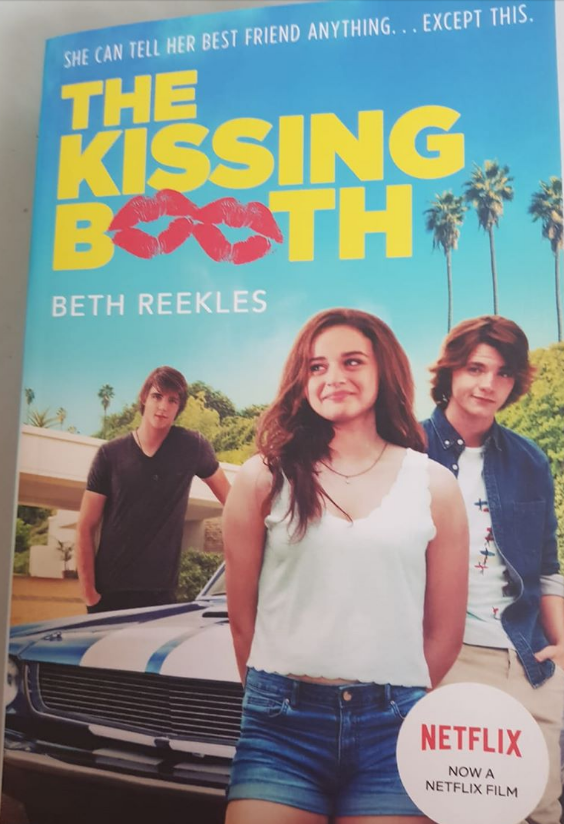
A Review of The Kissing Booth

The Kissing Booth is a book by Beth Reekles. Rochelle "Elle" Evans is best friends with Lee Flynn. They were born on the same day, and their Moms were best friends, too. His older brother, Noah, is the hottest guy in the school. Elle has a huge crush on him, as does most of the school, but he's way out of her league. When she and Lee decide to run a kissing booth at the school carnival, she's surprised when her first kiss is with Noah. They begin a secret relationship, hiding it from everyone, especially Lee.

Elle manages to fall into a huge pitfall of YA protagonists in these sort of books by not having any sort of personality outside of the guys. The movie did her a huge favour by giving her a love of playing football (soccer) and an interest in dancing. However, I liked that she's different for YA protagonists, which often focus on quiet, shy girls. She's no stranger to going to parties and having a bit to drink.

I would really like to see more types of friendship displayed in YA fiction, and this book does do that. It focuses on the friendship between Elle and Lee, almost as much as Elle's relationship with his older brother. From the Netflix movie, I thought they might get them together. I enjoyed the way they could mess around paint-fighting with each other, for example. But the book stays well away from making it into a love triangle, and I think that's a huge benefit. Teens need to see (and read about) boys and girls being good friends, and that girls can have friendships with boys that are as close as friendships with a group of girls. The friendship parts between Elle and Lee were some of my favourite parts of the book.

But for a book like this to be truly enjoyable, you have to be invested in the romance, and I just wasn't. Noah is a controlling jerk, to the point where I was hoping it would end with Elle realising she deserves better. He's been warning guys not to date Elle since even before the story starts, and seems to think he can tell her what to wear. To give you an idea, he reminds me of Christian Grey. This is partly why I'd been hoping that Elle would get together with Lee, instead, someone who she could have a laugh about with.

I am in awe of anyone who gets published as a teenager. Having the determination and discipline at that age to do something I still struggle to do at 26 is huge. This doesn't mean the book is immune from criticism because of her age, however. I wouldn't like to feel like people took it easy on me as a teenager, either. It's a Wattpad story, and it reads like a Wattpad story. Cliches abound, and it could have done with extra editing, too. I saw a few grammar mistakes that should have been caught, and it could do with being quite a lot shorter. Almost 450 pages for this kind of story is way too long. It's also obvious that it was written by a British author but set in America. Terms such as jumpers are used. At one point, Elle gets salted popcorn from a movie theatre, but none of the American movie theatres I've been to do salted popcorn - it's always buttery. And at one point, she says "The night air was cool compared to the heat inside" but in California in spring, that isn't likely. Outside would still be warm, and inside would have all air conditioners on max. Going outside is a nice way to warm up.

So my biggest criticism about this series is that it reads similarly to The Summer I Turned Pretty series. And published after, too, hmm. Moms who are very close best friends from college, one family consisting of two boys. Noah's personality even reminded me a lot of Conrad's.

Oh, and what Starbucks has waiters, anyway?

Netflix has done super things with this material, though, and the movie is worth a watch for sheer escapism on a rainy day. It manages the good balance between condensing the material and adding to it. It's lighthearted fun, and there's nothing wrong with that. To be honest, I recommend the movie over the book. It is sheer entertainment, but there's nothing wrong with things existing for the sole purpose of making people happy.

Tuesday, 2 October 2018

A Review of 13 Minutes

13 Minutes is a book by Sarah Pinborough. Natasha Howland winds up in a freezing cold river in mysterious circumstances. While underwater, she was dead for thirteen minutes, making a recovery described as miraculous. With suspicions falling on her friends Jenny Cole and Hayley Gallagher, it's up to her ex-best friend, Becca Crisp, to get to the truth.

So I actually didn't know this was UKYA when I picked it up! It's always nice when I can understand terminology easier and relate things to my own experience. I think the plotline and the "Mean Girls for an Instagram age" tagline conditioned me to expect a US story. I remember similar experiences with popular girls in my own school, so it isn't just a US phenomenon. The popular girls in the story even have a group name, similar to the Plastics. They're the Barbies.

Even though the story revolves around Natasha, the main character isn't Natasha, it is Becca. This is interesting as Becca's chapters are in third-person, and Natasha's are in first. It actually makes the way that Natasha is the centre of the book, and the only thing the characters are talking about, stand out. Everything is about Natasha. Spoiler: it also makes the books big twist a little harder to swallow. She has no reason to lie in her narration!

Natasha is likely asexual - she says she doesn't like the thought of it and pretends to go further than she actually has. But this line about it did truly annoy me: "It leaves me cold. Maybe I belong in the river."

Becca used to be fat, and there's an awful lot of comments about that, but there's also a very heavy focus given to how much other characters weigh, and the idea of dieting, which is almost unhealthy coming from a YA book.

There is an awful lot of girl-hate. The plot might make this seem obvious, but some writers to subvert some of the standard cliches about this. Becca herself is hateful towards the Barbies and Natasha's internal narration is also mean towards them, too. Becca also complains about the girl who is apparently her best friend, Hannah, who is described as "that boring girl from school who's name no-one would remember in five years time."

Being a UKYA book, it does do that UKYA thing of showing teenagers doing authentic teenage things - they smoke, have sex, drink and try drugs. But I'd also just once to have a book focus on the kind of teenager I was. I didn't drink until I was 17, and even then minimally, I didn't have sex until I was in my twenties.

I'm also not sure if the dialogue is authentically teenage or not. To give an example, at one point Natasha writes in her diary that "How many other people have their death reported in inverted commas?" Would a teenager say 'inverted commas' or would they use the term speech marks? Well, I guess it would depend on the teenager, but an adult writer has a significantly higher chance of knowing the correct term for punctuation.

Spoiler: Saying this book is like Gone Girl is probably going to be a huge giveaway for people familiar with that book. A lying, sociopathic woman, a falsified diary and an unreliable narrator? However, there is a difference between unreliable and intentionally misleading, and I think this book is way too far into it. It makes no sense for Natasha to still be lying in her first-person narration, and even the blurb makes it seem like Natasha doesn't know as much as she does.

I would recommend this for other fans of page-turning thrillers, but please bear in mind some of the problematic content. I hate linking a book to other books, but it does remind me of a British YA Gone Girl.

Tuesday, 18 September 2018

A Review of The Exact Opposite of Okay

The Exact Opposite of Okay is a book by Laura Steven. Izzy O'Neill has been raised by her grandmother Betty since losing both her parents in a car crash. They get by with Betty's income from her job in a diner. Izzy wants to write humourous scripts for TV, but she feels her dream may not come true because of their lack of money. However, when an account of two sexual encounters she had at a party goes viral, Izzy finds herself the centre of much unwanted attention.

Basically every character who wasn't awful was a delight. Betty is the Grandmother I'd always wanted. Supportive teachers also amaze me. I loved that Izzy was given the $50 with no expectation to succeed or pay it back, just because it would be a great experience for her to try, even if she didn't win. And her romance was adorable in how well it fitted her. It's not cute in the general sense, but they do get on well. It was shallow, but then again, it's not the main focus of the book. If it was necessary to have a romance is another topic, but here I think it works. He also does show that not every male in this book is awful, so I would say that the romance was a necessary inclusion. There are also characters with shades of grey, such as Zack. It must be awful having most conversations you have bring up your father in some way, and I would have actually liked to see more of him as a reasonable human being. Ajita is basically the best best friend you could want in Izzy's circumstances, too.

Spoiler: I didn't want to spend any review time talking about Daniel, but I guess I would have to bring him up somewhere. Boy, does he remind me of some guys I've dealt with. What. An. Arsehole. [/spoiler]

What Izzy goes through is not dissimilar to similar events that have happened to real people. I'm thinking predominantly of leaking of celebrity nudes and revenge porn, but some people may know other examples. I was going to say "her life shouldn't be ruined because of a mistake" but it wasn't even a mistake, because it literally shouldn't have happened to her in the first place. Even her sending nudes was well within the bounds of acceptability. Izzy's eighteen*, making this an adult deciding to do something just for the hell of it. If you think it was wrong, I suggest rereading this book, and ask yourself why.

Izzy does make a serious mistake at one point, when she tells that Ajita is gay. This wasn't Izzy's thing to tell people - Ajita gets to decide who knows and when and how to tell them. However, much of the audience of this book will likely be teenagers. Some of them may not be aware of the consequences of giving away someone's sexuality and why you shouldn't do it. I'm not saying that makes Izzy's actions in the book okay, but it does mean people may learn something. Izzy is only a teenager, herself, and therefore will make mistakes. It's only natural. And no, being a full adult in the eyes of the law and still being a teenager prone to errors in judgement can coexist. Even at eighteen, you won't know everything, and you can still develop as a person as an adult.

I will say that some of the syntax reads more British than American. It can be jarring for those who are not used to it. Expect it before going in, remember that it is written by a British writer, and bear in mind that there are a lot of books set in Britain where Americanisms have crept in, too. Those sort of books can throw me right out of the story when I read them. If I'm honest, it still threw me off in this one, too, but I'll give it a pass.

Edit:  Since I didn't state this anywhere, the reason British terms sound weird in this book is because it is set in America, but written by a UK author.

* If you are under eighteen, however, please don't send nudes, ever, because distribution and possession of them comes under child pornography laws. Make sure whatever you do is safe and legal. I am disappointed that this point was never brought up, because this book could have been a good way to educate the target audience on best practice for sending nudes. In addition to "don't do it if you're underage" there's also "don't show any identifying features" and "only share them with people you trust." As well as if they ever do get leaked, it is absolutely, 100% not your fault.

I would recommend this book to anyone growing up and trying to make sense of how women are treated in society.